
Making sense togheter: learning the ORBIS toolkit
This short online training offers a clear, practical, and accessible introduction to the ORBIS toolkit and its socio-technical approach to AI-supported democratic deliberation.
The first introductory video, produced by Politecnico di Milano, explains how artificial intelligence can be used to support — rather than replace — democratic participation. It presents the ORBIS toolkit, designed to transform large volumes of complex public input into clear and explainable insights for decision-making.
The following videos show how this ORBIS toolkit comes to life through three complementary platforms.
The second video, developed by The Open University, introduces Democratic Reflection, a tool designed to capture, analyse, and reflect participants’ perceptions and experiences throughout deliberative processes. The third video focuses on BCause, also developed by The Open University, which supports the structuring and visualisation of complex public arguments. The fourth video, produced by I Copernicani, presents PolisOrbis, illustrating how large-scale online conversations can be organised to identify areas of agreement and disagreement among participants.
By the end of the four videos, users gain a clear overview of the ORBIS socio-technical solution and a practical understanding of how each toolkit can be used—individually or in combination—to design, support, and evaluate participatory and deliberative processes.
Why online training videos?
The decision to produce a series of online training videos has significantly increased the reach and long-term usability of ORBIS training outputs. All stakeholders — including citizens, researchers, facilitators, public authorities, and civil society organisations — can access the tutorials without registration or time constraints.The materials will remain available beyond the end of the project, supporting sustained adoption, capacity building, and future research activities.
The videos are designed to be reusable in a variety of contexts, such as academic teaching, professional training programmes, and civic tech communities, thereby amplifying the visibility and impact of ORBIS outcomes. The online format also enhances accessibility for diverse user groups, including those unable to participate in live training events.
From voices to insights: the ORBIS toolkit
By Politecnico di Milano
The introductory video will guide you through what makes ORBIS unique and relevant. It explains how the ORBIS toolkit turns large volumes of public input into clear, transparent insights through four components: argument mining, feedback aggregation, explanation generation and policy recommendations. Through concrete examples, the video shows how policymakers, facilitators and researchers can use ORBIS to design more inclusive, informed and meaningful participatory processes.
Democratic Reflection: real-time insights from live debates
By Open University
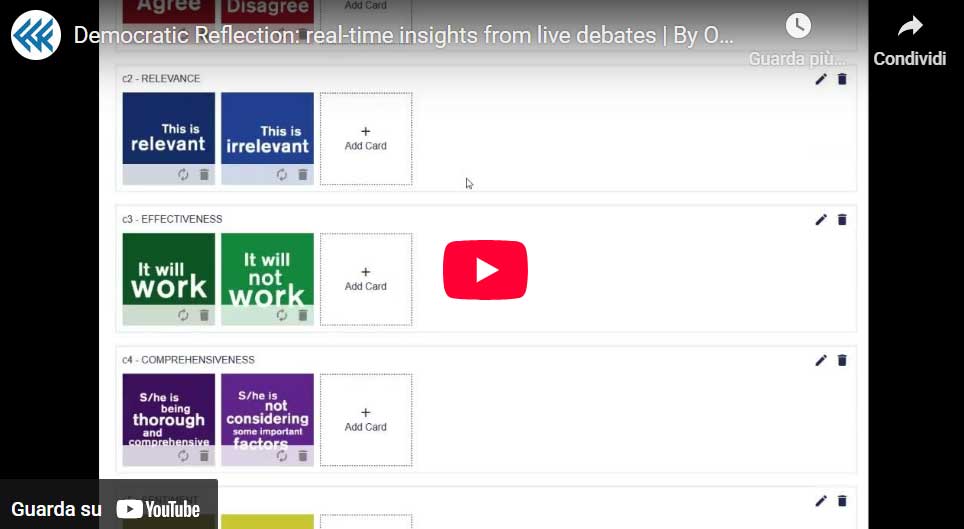
This tutorial introduces Democratic Reflection, an interactive platform that transforms live debates and video events from passive viewing into active, reflective participation. It shows how participants respond in real time through digital reflection cards, while the system captures their inputs and generates visual analytics on engagement, sentiment and key arguments. The video also walks through the event flow—from informational pages and surveys to live debate and post-event summaries—demonstrating how Democratic Reflection supports deeper understanding, inclusive dialogue and richer analysis for both organisers and participants.
BCause: structuring online debate with AI
By Open University
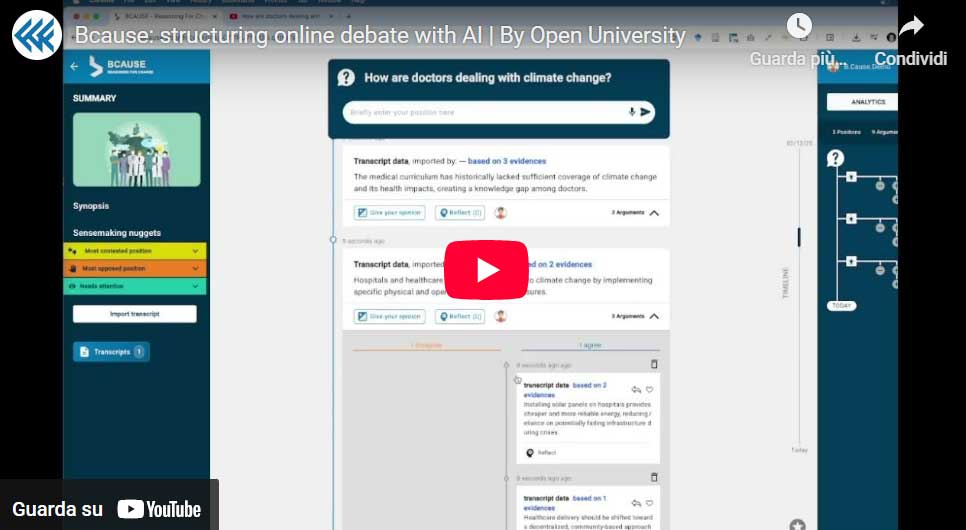
This tutorial presents BCause, a platform that turns scattered online dialogue and raw transcripts into structured, meaningful deliberation using the IBIS argumentation framework. It shows how AI is used to extract positions and arguments from debates, apply argument mining to highlight claims and premises, and provide rich visual analytics—from thematic clustering to argument networks—that reveal the logic, conflicts and consensus behind complex conversations.
PolisOrbis: large-scale participation made simple
By Copernicani